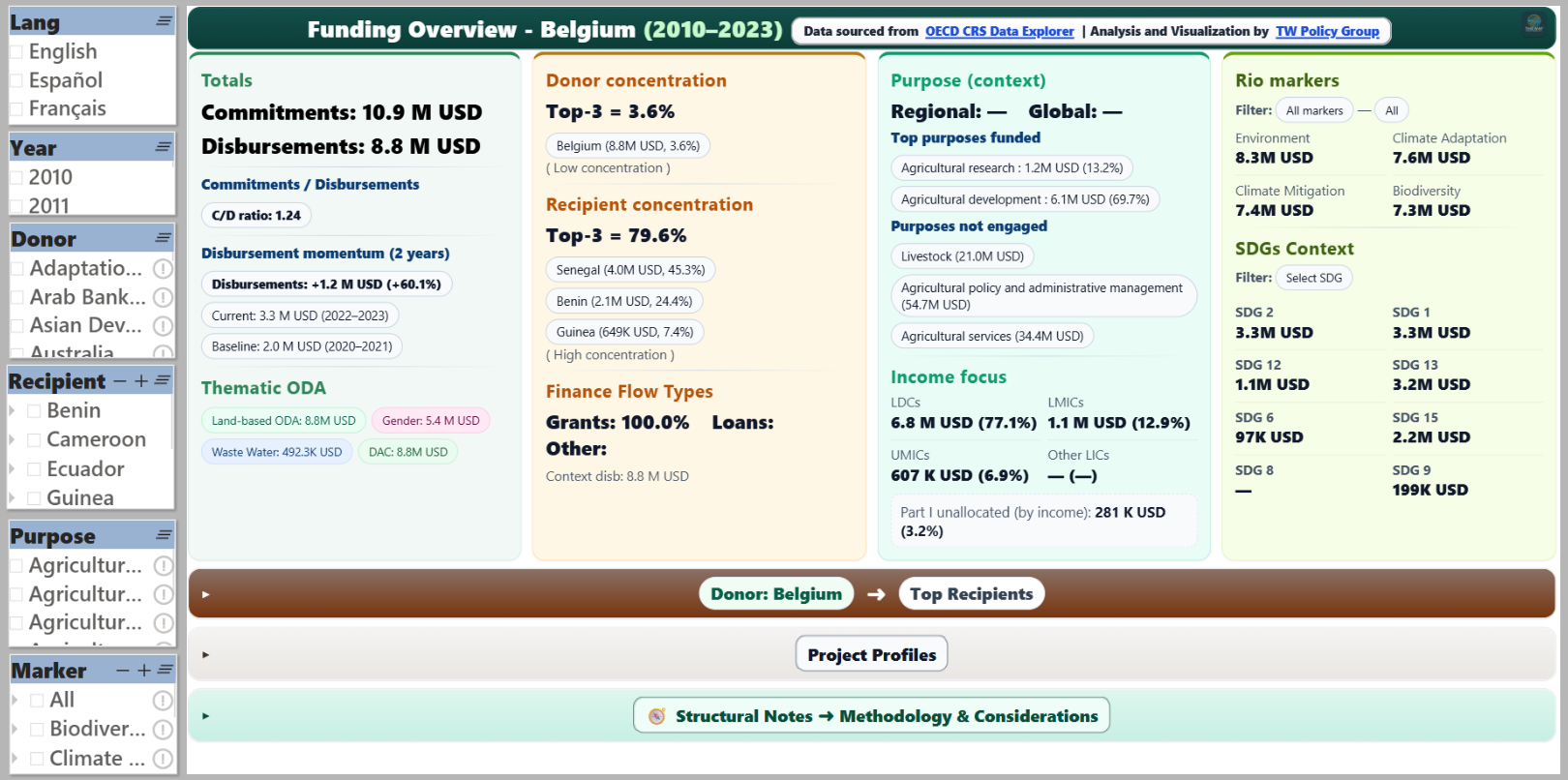
Agriculture ODA Scale
Total agriculture-related ODA reached $10.9B in commitments and $8.8B in disbursements across the 2010–2023 horizon, positioning agriculture as one of the largest sectoral ODA envelopes globally.
Agricultural Finance Intelligence · 2010–2023
Premium-access dashboard powered by OECD CRS / DAC Aid Activity data, developed by TW Policy Group to track Official Development Assistance flows for agriculture, food systems, and rural development initiatives — donors, recipients, project values, finance modalities, and purpose classifications. Built to support evidence-based agri-food investment strategy, ODA programming, food-systems planning, and alignment with SDG 2, AfCFTA, and global food security priorities.
Total agriculture-related ODA reached $10.9B in commitments and $8.8B in disbursements across the 2010–2023 horizon, positioning agriculture as one of the largest sectoral ODA envelopes globally.
Grants dominate the finance architecture, with concessional loans forming a significant secondary channel. The balance between modalities reflects the mix of humanitarian, resilience, and long-term food-system programming.
The largest purposes funded span agricultural development, food security policy, rural development, and agricultural research — reflecting a blend of production support, governance reform, and systems investment.
LDCs and lower-middle-income countries absorb the largest shares of agriculture ODA, reflecting the alignment of donor programming with countries facing the highest food insecurity and rural transformation needs.
29 bilateral and multilateral donors contribute to the agriculture ODA envelope, with a small number of major donors accounting for a disproportionate share — creating both coordination opportunities and concentration risks.
Built for donor coordination, agricultural strategy, agri-food portfolio benchmarking, recipient opportunity scanning, SDG 2 alignment, and executive-ready communication across government and development partners.
This page is fully dynamic. Use the embedded dashboard to explore ODA flows for agriculture and food system initiatives, track donor and recipient trends, and analyse project-level investment patterns across 13+ years of DAC data.
What you'll see: an interactive ODA intelligence interface showing how official development assistance for agriculture is allocated — by donor, recipient country, purpose code, income group, finance modality, and disbursement trajectory.
Built on the OECD Creditor Reporting System (CRS), the authoritative global reference for bilateral and multilateral ODA activity data, published by the OECD Development Assistance Committee (DAC).
The OECD CRS database is updated annually as DAC members submit activity-level reporting for the previous calendar year.
TW Policy Group applies a consistent, transparent processing layer over the raw CRS data to ensure cross-donor, cross-recipient, and cross-time comparability.
The overview surface collapses 14 years of agriculture and food system ODA into a single readable dashboard. Designed as the entry point for development professionals, agricultural policymakers, and donor strategists who need a high-level situational read before exploring specific corridors, donors, or recipient groups.
Track ODA flows to agriculture and food systems across donors, recipients, and funding instruments to understand who is investing in what, where, and at what scale.
Identify the major bilateral and multilateral financiers, analyse donor concentration, and map gaps in the official support architecture for sustainable agriculture.
Compare ODA per capita, agricultural GDP share, and income group allocations to surface underfunded recipients and frame the case for reprogramming or scale-up.
Link ODA flows to Zero Hunger targets, AfCFTA agricultural provisions, and regional food system commitments to demonstrate strategic coherence and mobilise partners.
Translate ODA landscape data into investment priorities for value chains, irrigation, crop research, market access, rural infrastructure, and food security programmes.
Expose the pipeline gap between pledged and delivered ODA to inform implementation performance monitoring and accountability conversations with donors.
Use polished dashboard snapshots and filtered views to produce briefing notes, board presentations, donor dialogues, and strategic memoranda on agriculture finance.
Extend the dashboard with additional subsectors, country modules, climate-finance overlays, AI Q&A, custom KPIs, and related agri-food intelligence over time.
Data & Attribution. This page presents a TW Policy Group visualization and ODA intelligence interface built on OECD Creditor Reporting System (CRS) data. Any underlying source datasets, purpose classifications, or methodology notes should be cited separately where applicable.
Open Access. Published as a public reference to support evidence-based agriculture and food system policy, ODA programming, and alignment with global frameworks (SDG 2, AfCFTA, WTO Agricultural Agreement). Redistribution is permitted with clear attribution to the OECD DAC as the data source and TW Policy Group for the analysis and visualization. Please consult OECD's ODA data terms and attribution guidance on the official OECD website.
No endorsement. The OECD does not endorse any findings or interpretations contained in this dashboard. Any errors or interpretations are the sole responsibility of TW Policy Group.
Share a question, request an enhancement, or flag a data issue. Your feedback helps improve usability, interpretation, and strategic value of the Agriculture ODA dashboard.
Receive updates on new agriculture ODA and agri-food dashboards, methods notes, and opportunities for tailored analysis.