
Feedback & Questions
Share a question, request an enhancement, or flag a trade-data issue. Your feedback helps improve usability, interpretation, and strategic value.
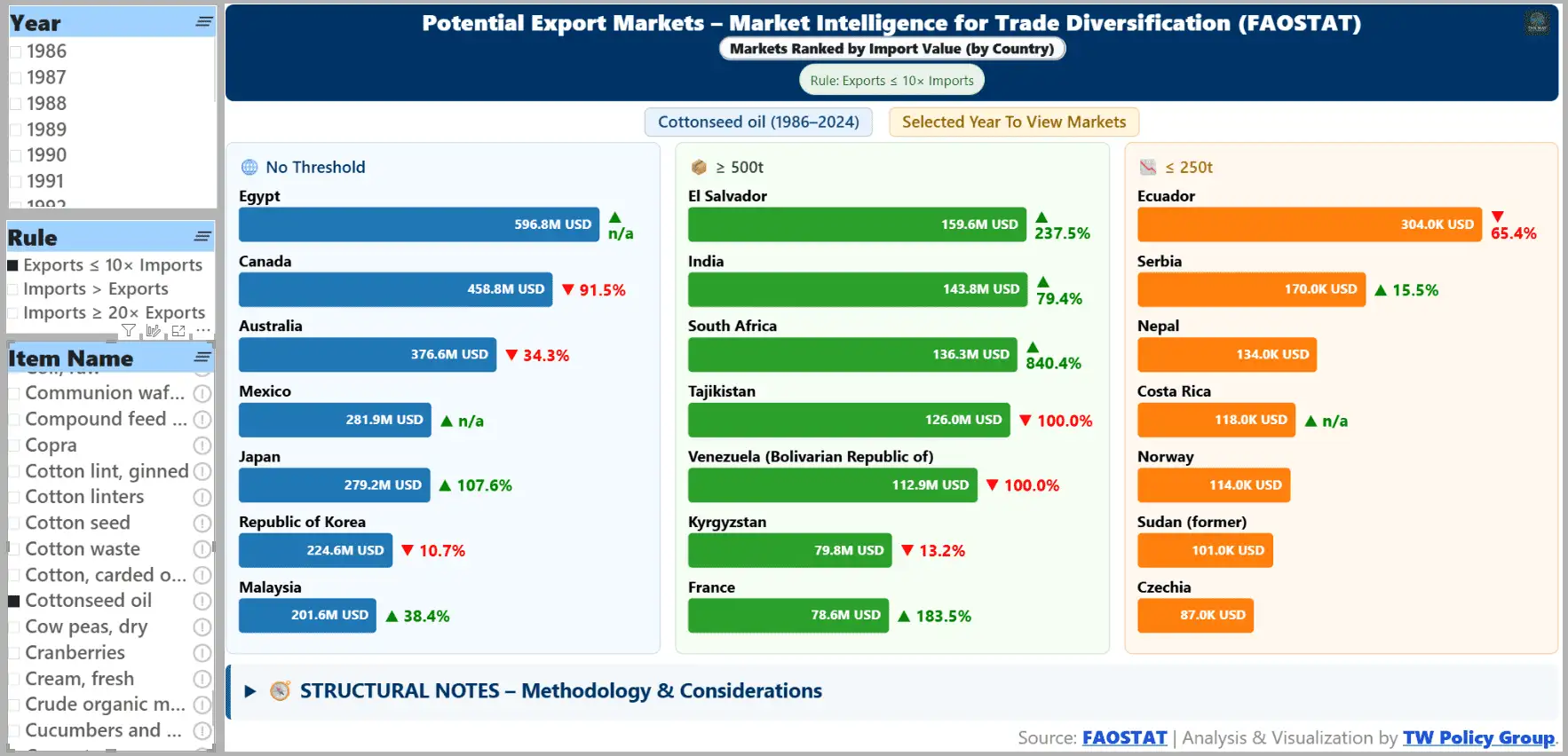
This page is fully dynamic. Use the embedded dashboard to view trade relationships, detailed product flows, and comparative market structures across countries and regions.
What you’ll see: an interactive trade matrix and professional dashboard views showing how agricultural trade evolves across reporters, partners, products, and trade directions.
Built on the FAOSTAT Detailed Trade Matrix, published by the Food and Agriculture Organization of the United Nations — the authoritative global reference for bilateral agricultural trade.
FAOSTAT releases annual updates to the Detailed Trade Matrix as new country submissions are validated and reconciled.
TW Policy Group applies a consistent, transparent processing layer over the raw FAOSTAT data so comparisons across reporters, partners, and products remain reliable.
The executive overview collapses 38 years of bilateral agricultural trade into a single readable surface. It is designed as the entry point for analysts, negotiators, and senior decision-makers who need situational awareness before drilling into specific corridors or products.
Track agricultural trade relationships across reporters, partners, and commodities to understand who trades what, with whom, and at what relative scale.
Use the matrix to identify concentration risks, bilateral dependence, diversification opportunities, and structural imbalances relevant for negotiations and policy reform.
Identify concentration risks, underused destinations, and promising product corridors to inform export promotion, market access, and investment planning.
Translate trade patterns into investment priorities for value chains, logistics, standards, market access, regional trade facilitation, and rural transformation..
Compare countries, regions, trade corridors, and products across time, in one structured environment to prioritize programs, partnerships, and resource allocation.
Use polished matrix snapshots and filters to create briefing notes, board presentations, partner updates, and strategic memoranda.
Embed the dashboard in national portals, programme websites, and internal analytical workflows for ongoing monitoring and rapid trade intelligence access.
Extend the page with more products, country modules, tariff overlays, AI Q&A, custom KPIs, AI summaries, and related trade policy intelligence over time.
Data & Attribution. This page presents a TW Policy Group visualization and trade intelligence interface built for public-use analysis and decision support. Any underlying source datasets, trade classifications, or methodology notes should be cited separately where applicable.
Open Access. Published as a public reference to support evidence-based trade policy, market access analysis, and alignment with global frameworks (WTO, AfCFTA, RTAs). Redistribution is permitted with clear attribution to FAO as the data source and TW Policy Group for the analysis and visualization. Please consult FAO’s Data Terms of Use and attribution guidance on the official FAO website.
No endorsement. FAO does not endorse any findings or interpretations. Any errors or interpretations are the sole responsibility of TW Policy Group.
Share a question, request an enhancement, or flag a trade-data issue. Your feedback helps improve usability, interpretation, and strategic value.
Receive updates on new trade dashboards, methods notes, and opportunities for tailored analysis.