Investors & Agribusinesses
- Identify expanding export and import markets
- Compare product and partner concentration
- Support sourcing, market-entry and investment due diligence
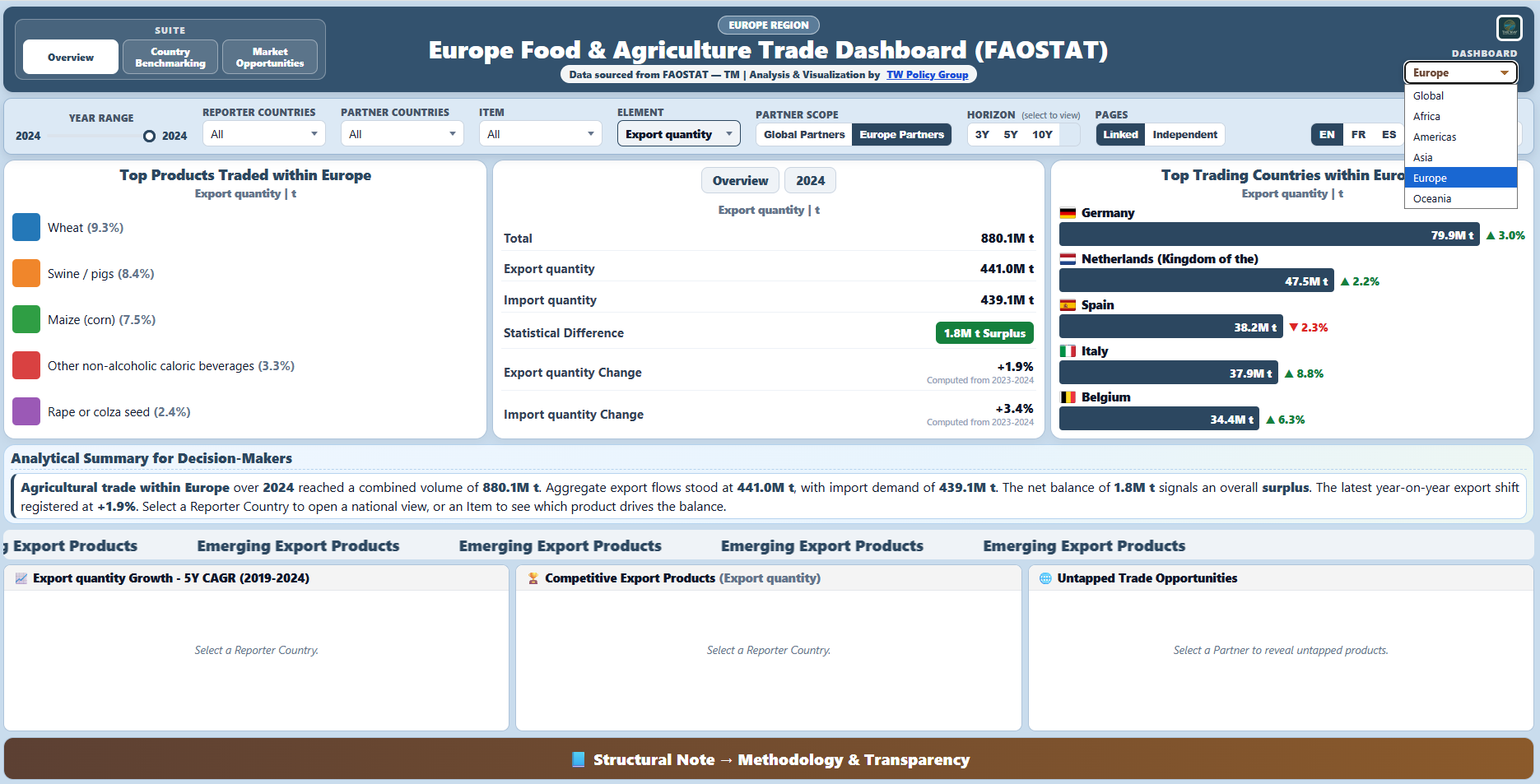
Premium-access dashboard developed by TW Policy Group to track European food and agriculture trade flows, bilateral trade, trade balances, product dynamics, reporter–partner linkages, country benchmarking, and market opportunities. Built to support sourcing, export diversification, food import resilience, regional connectivity and evidence-based trade strategy across European and global markets.
The full suite brings historical trends, products, partners, quantities, values and market opportunities into one analytical environment.
Every subscription provides the complete trade analysis experience for the selected scope.
Choose the level of Europe-focused trade analysis your organisation needs, from complete continental coverage to advanced bilateral analysis, country benchmarking, market opportunity tools and organisation-wide access.
Core Europe trade analysis
per year
Benchmarking and market opportunities
per year
Advanced regional trade analysis
per year
Organisation-wide Europe trade access
per year
Order an executive-ready report prepared from the same FAOSTAT trade framework that powers the Europe dashboard. Choose a focused country assessment or a deeper market-opportunity study.
A concise national trade profile and executive briefing.
A deeper export, import and partner-market opportunity assessment.
Track import and export growth across countries, products and bilateral corridors to identify structural momentum and emerging markets.
Analyse reporter–partner linkages to understand the relationships carrying the greatest value and the markets shaping each country's trade position.
Rank products by trade value, growth and share to identify the commodities driving exports, imports and bilateral exchange.
Measure partner and product concentration to identify reliance on a narrow set of suppliers, destinations or commodities.
Benchmark countries using consistent indicators for trade scale, growth, balance, concentration and market structure.
Screen potential export destinations and import sourcing markets using observed trade demand, existing capabilities and partner-market evidence.
This page is fully dynamic. Use the dashboard to examine Europe food and agriculture trade relationships, bilateral product flows, partner concentration, trade balances and market opportunities.
What you will see: regional trade views showing how imports and exports evolve across reporters, partners, products, partner scopes and time horizons.
The dashboard is built on the FAOSTAT Detailed Trade Matrix and filtered to Europe reporter countries and territories, regional partners and trade with the rest of the world.
Opportunity analysis is designed as an evidence-based screening tool rather than a forecast or guaranteed commercial recommendation.
Data & Attribution. This page presents a TW Policy Group visualization and trade dashboard built on FAOSTAT Detailed Trade Matrix. Analysis and interpretation are TW Policy Group’s own.
No endorsement. FAO does not endorse any findings or interpretations contained in this dashboard. Any errors or interpretations are the sole responsibility of TW Policy Group.
Share a question, request an enhancement, or flag a data issue. Your feedback helps improve usability, interpretation and strategic value of the Europe Food & Agriculture Trade dashboard.
Receive updates on new Europe trade dashboards, methods notes, country modules and tailored agricultural analysis.