
Africa Food & Agriculture Trade Dashboard
FAOSTAT Detailed Trade Matrix (1986 to 2024)
Premium-access dashboard developed by TW Policy Group to track African food and agriculture trade flows, intra-African and global bilateral trade, trade balances, product dynamics, reporter–partner linkages, country benchmarking, and market opportunities. Built to support evidence-based trade strategy, export diversification, food systems planning, AfCFTA implementation, regional integration, multilingual analysis and alignment with continental and Africa trade priorities.
What decisions can this dashboard help you make?
Investors & Agribusinesses
- Identify expanding export and import markets
- Compare product and partner concentration
- Support sourcing, market-entry and investment due diligence
Government and Development Partners
- Monitor food import dependence and trade balances
- Benchmark national and regional trade performance
- Prioritise export development, diversification and value-chain resilience
Researchers & Advisors
- Analyse bilateral trade relationships and historical shifts
- Compare countries, commodities and trading partners
- Produce decision-ready evidence for briefs and strategies
Africa Food & Agriculture Trade · Interactive DashboardExplore the public global preview, then unlock historical trends, bilateral trade, country benchmarking, market opportunities, executive summaries and multilingual analysis.
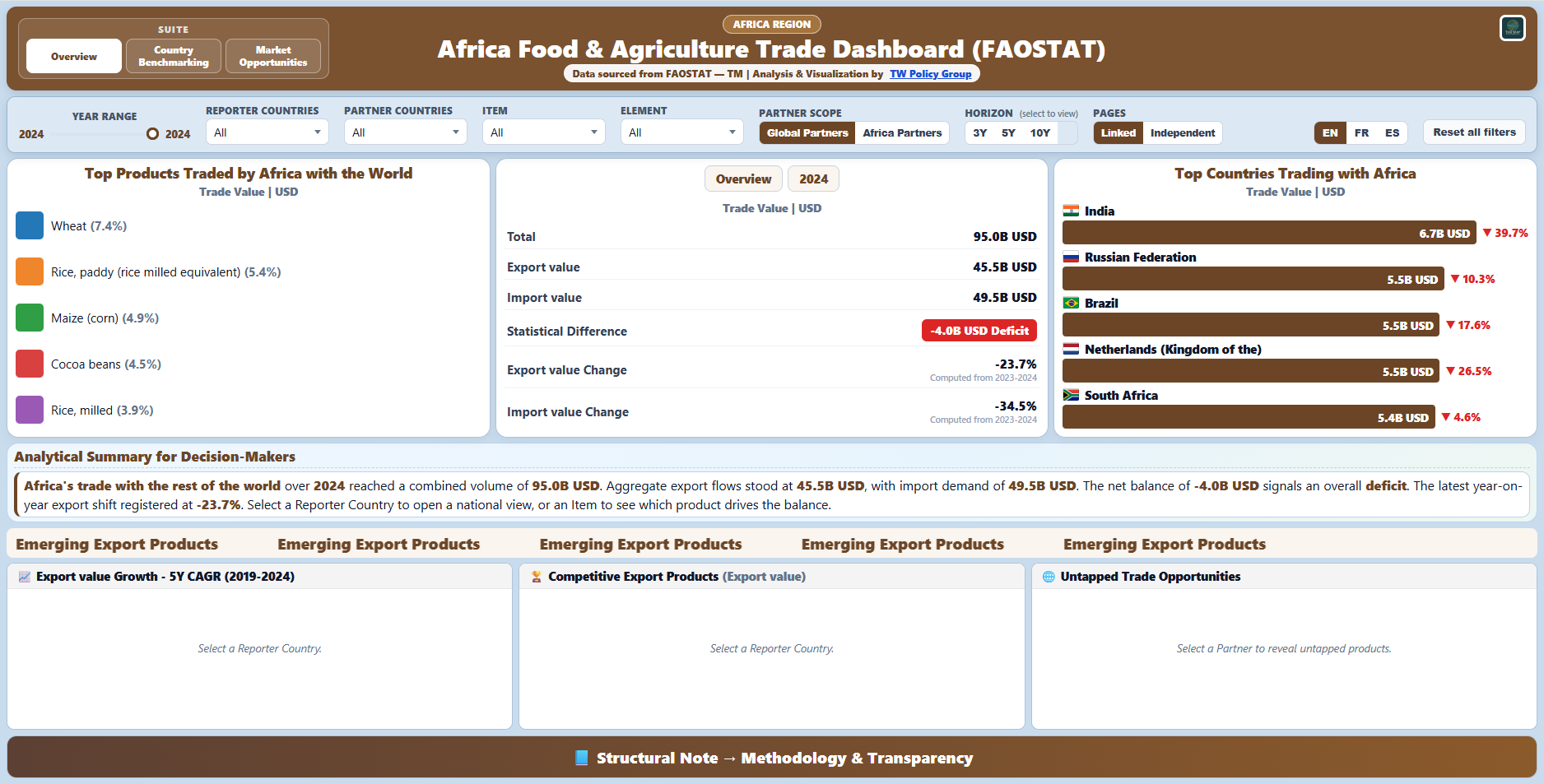
See the continental trade picture before drilling into detail
The opening view brings together Africa’s imports, exports, trade balance, leading products and major external partners in one coordinated overview.
- Establish the continent-wide trade baseline.
- Identify leading products, markets and external partners.
- Move from the regional picture into detailed country analysis.
Everything included in your access
Every subscription provides the complete trade analysis experience for the selected scope.
Africa Food & Agriculture Trade Dashboard Plans
Choose the level of Africa-focused trade analysis your organisation needs, from complete continental coverage to advanced bilateral analysis, country benchmarking, market opportunity tools and organisation-wide access.
Essential
Core Africa trade analysis
per year
- Complete Africa Food & Agriculture Trade Dashboard
- Historical coverage from 1986 to 2024
- African imports, exports and trade balances
- Reporter, partner, product and year analysis
- Intra-African and rest-of-world partner scopes
- Country, product and partner rankings
- Interactive charts and executive summaries
- English, French and Spanish interface
- Annual updates and email support
Professional
Benchmarking and market opportunities
per year
- Everything in Essential
- Detailed bilateral reporter–partner analysis
- Country benchmarking across Africa
- Export Market Opportunity Explorer
- Import sourcing and supplier analysis
- Partner and product concentration indicators
- Advanced historical comparisons
- Multilingual executive analysis
- Priority data and feature updates
Business
Advanced regional trade analysis
per year
- Everything in Professional
- Advanced country and market benchmarking
- Intra-African trade corridor analysis
- Export diversification assessment
- Food import dependence diagnostics
- Trade concentration and resilience signals
- AfCFTA and regional integration analysis
- Executive reporting and briefing support
- Download-ready analytical visualisations
Enterprise
Organisation-wide Africa trade access
per year
- Everything in Business
- Complete Africa dashboard experience
- Integrated global comparison access
- Cross-regional benchmarking workflow
- Institutional licensing and team access
- Organisation onboarding and deployment support
- Executive summaries and comparative analysis
- Premium support
- Early access to new features and releases
Country & Market Opportunity Reports
Order an executive-ready report prepared from the same FAOSTAT trade framework that powers the Africa dashboard. Choose a focused country assessment or a deeper market-opportunity study.
Africa Country Trade Report
A concise national trade profile and executive briefing.
one time
- One selected African country
- Imports, exports and trade balance
- Leading products and trading partners
- Intra-African and rest-of-world trade structure
- Historical trade trends and growth
- Product and partner concentration
- Decision-maker executive summary
- Professional PDF report
Africa Market Opportunity Report
A deeper export, import and partner-market opportunity assessment.
one time
- One selected country and priority product or market theme
- Export and import opportunity screening
- Bilateral trade and partner-market analysis
- Country and regional benchmarking
- Trade concentration and diversification diagnostics
- Food import dependence and resilience signals
- Strategic recommendations and executive findings
- Professional PDF report and presentation deck
What this trade platform helps you answer
Where is trade growing?
Track import and export growth across countries, products and bilateral corridors to identify structural momentum and emerging markets.
Who trades with whom?
Analyse reporter–partner linkages to understand the relationships carrying the greatest value and the markets shaping each country's trade position.
Which products matter most?
Rank products by trade value, growth and share to identify the commodities driving exports, imports and bilateral exchange.
Where are the dependency risks?
Measure partner and product concentration to identify reliance on a narrow set of suppliers, destinations or commodities.
How does one country compare?
Benchmark countries using consistent indicators for trade scale, growth, balance, concentration and market structure.
Where are the opportunities?
Screen potential export destinations and import sourcing markets using observed trade demand, existing capabilities and partner-market evidence.
How to use the Africa Food & Agriculture Trade Dashboard
This page is fully dynamic. Use the dashboard to examine African agricultural trade relationships, bilateral product flows, partner concentration, trade balances and emerging export opportunities in a decision-ready format.
What you will see: African trade views showing how imports and exports evolve across reporters, partners, products, partner scopes and time horizons.
- Start with Africa-wide context: review the continental trade structure before narrowing to one country.
- Filter strategically: refine by Year, Reporter, Item, Partner, Partner Scope and Horizon.
- Track trade direction: examine who exports to whom, where import dependence is concentrated and how partner linkages change.
- Assess trade balance: compare exports, imports, total trade and deficits or surpluses for the selected reporter.
- Identify concentration risk: use leading products and partners to detect dependence on a narrow set of commodities or markets.
- Read growth and competitiveness: analyse emerging products, stronger export positions and potential market opportunities.
- Use the findings for policy and investment planning: support country strategies, AfCFTA analysis, donor programming and market-entry decisions.
How the trade dashboard is built
Data source and Africa coverage▾
The dashboard is built on the FAOSTAT Detailed Trade Matrix and filtered to African reporter countries, their intra-African partners and their trade with the rest of the world.
- 54 African reporter countries with available records in the regional dataset.
- 252+ actively traded agricultural products represented in the Africa dashboard.
- Historical coverage from 1986 to 2024.
- Partner scopes: within Africa and rest of world.
- Trade directions: imports and exports.
- Languages: English, French and Spanish.
Core calculations▾
- Total trade combines imports and exports for the selected analytical context.
- Trade balance is calculated as exports minus imports.
- Historical growth compares selected years and periods using consistent trade values.
- Partner and product concentration measure how strongly trade depends on leading markets or commodities.
- Country benchmarking applies a consistent indicator framework across selected economies.
Market-opportunity interpretation▾
Opportunity analysis is designed as an evidence-based screening tool rather than a forecast or guaranteed commercial recommendation.
- Export opportunity views connect existing export capability with observed destination-market demand.
- Import opportunity views identify current supplier structures and potential alternative sourcing markets.
- Users should combine dashboard findings with tariffs, logistics, standards, commercial research and national statistics before investment decisions.
Updates and interpretation notes▾
- The dashboard is refreshed when the latest validated FAOSTAT trade data are integrated.
- The most recent years may be revised as national submissions are updated.
- Reporter and partner values can differ because of timing, valuation, classification and reporting practices.
- High trade value does not by itself establish competitiveness, profitability or market accessibility.
Data & Attribution. This page presents a TW Policy Group visualization and trade dashboard built on FAOSTAT Detailed Trade Matrix. Analysis and interpretation are TW Policy Group’s own.
No endorsement. FAO does not endorse any findings or interpretations contained in this dashboard. Any errors or interpretations are the sole responsibility of TW Policy Group.
Feedback & Questions
Share a question, request an enhancement, or flag a data issue. Your feedback helps improve usability, interpretation and strategic value of the Africa Food & Agriculture Trade dashboard.
Subscribe for Updates
Receive updates on new Africa trade dashboards, methods notes, country modules and tailored agricultural analysis.