Global Crops & Livestock Production
FAOSTAT Production Intelligence

Global Agricultural Production Analytics Β· 1961–2024

Premium global production dashboard powered by FAOSTAT production data, developed by TW Policy Group to track long-run crops and livestock output, harvested area, yield, stocks, producing animals, slaughtered animals, and related structural signals across 217 countries and territories. Built to support agricultural policy analysis, food system strategy, value chain investment, and alignment with SDG 2, national food security frameworks, and global agri-food competitiveness priorities.

217+ Countries / Territories global coverage
273 Products crop & livestock items
63+ yrs Time Horizon 1961 – 2024
8 Elements production, yield, stocks, animals
7 Units tonnes, ha, kg/ha, head & more
πŸ”Ž Filter by Country / Territory Item / Product Element Unit Year Top Rankings Signals

🌍 Global Crops & Livestock Production β€” Interactive Dashboard

Executive Snapshot

Global Production Scale

This dashboard brings together 63+ years of global agricultural production data, covering both crops and livestock systems across 217 countries and territories β€” allowing users to read structural change, growth, and concentration over time.

Multi-Element Intelligence

Users can shift between 8 elements including production, yield, harvested area, stocks, producing animals, slaughtered animals, and laying or milk-animal counts β€” enabling context-specific analysis rather than one-size-fits-all totals.

Product Breadth

With 273 products spanning staple crops, horticulture, industrial crops, and animal products, the dashboard supports broad sector intelligence as well as deep dives into a single commodity or livestock category.

Country Benchmarking

Country filters reveal how a selected economy performs relative to the world distribution, making it possible to identify leaders, laggards, emerging producers, and overlooked mid-tier performers across different production metrics.

Signal-Driven Reading

The policy signal section translates raw numbers into interpretation β€” highlighting growth momentum, concentration patterns, dominance of top products, and structural shifts in the currently selected element, item, or country context.

Decision Use

Built for ministries, agribusinesses, researchers, investors, and development partners who need robust production evidence for food systems strategy, trade readiness, import substitution, export planning, and agricultural transformation.

Quick User Manual

This page is fully dynamic. Use the embedded dashboard to explore global crops and livestock production patterns, benchmark countries, isolate products, and interpret long-run growth and structural change.

What you'll see: an interactive production intelligence dashboard showing how agricultural output evolves across countries, items, and elements β€” with rankings, time series, and policy signals that update instantly to your selection context.

  • Start with the element slicer: choose exactly one element first, because totals and rankings depend on the selected production concept and its compatible unit.
  • Then read the overview: review global totals, dominant countries, and top products for the selected element and year range.
  • Filter by country: isolate one country or territory to see its leading products, historical trajectory, and how its production profile compares to global peers.
  • Filter by item: focus on one product such as avocado, maize, cattle meat, or milk to identify the countries driving supply and how their positions evolved over time.
  • Use the unit carefully: the dashboard contains seven units, so interpret production, area, yield, stocks, and animal counts within their correct measurement system.
  • Read the signals panel: it dynamically adapts to the selected element, country, and item to explain momentum, concentration, and structural dominance in plain language.
  • Benchmark for strategy: use rankings and time series to identify competitive producers, productivity leaders, underperforming systems, and export-oriented opportunities.

How this dashboard is built

01 Data Source & Coverage

Built on FAOSTAT production data, this dashboard consolidates a long-run global production series for crops and livestock into a unified intelligence interface for benchmarking and policy analysis.

  • 217 countries and territories providing truly global analytical coverage.
  • 273 products spanning crops, horticulture, commodities, and livestock-related outputs.
  • 1961–2024 time horizon enabling long-run structural comparison across more than six decades.
  • 8 elements and 7 units preserved to keep each production concept analytically valid.
  • Dashboard logic is selection-driven: users should choose one element to activate consistent totals, rankings, and signals.
02 Refresh Cadence & Data Maintenance

The dashboard is updated when the underlying FAOSTAT production series is refreshed and integrated into the TW Policy Group model.

  • Latest horizon currently extends to 2024, enabling near-current agricultural production tracking.
  • Historical continuity is preserved so users can compare latest values against long-run baselines and turning points.
  • Normalization layer harmonises crops and livestock production structures into one model while keeping element-unit integrity intact.
  • Where FAOSTAT revises prior-year values, those revisions should flow into subsequent model refreshes for consistency.
03 Methodology & Interpretation Notes

This dashboard is designed to prevent invalid comparisons by keeping the selected element and unit at the center of the analytical logic.

  • Element-first design: production, yield, area, stocks, and animal counts are never aggregated into one misleading total.
  • Unit-aware ranking: each ranking updates only within the currently selected measurement system.
  • Country and item signals: the policy signal section adapts to a selected country, item, or both, making the narrative more decision-grade.
  • Top-country and top-item views: rankings identify dominant producers, but should always be read alongside the time series and signal panel.
  • Caution: high production volume does not necessarily imply high productivity, export competitiveness, or sustainability. Use yield, area, and related indicators together when forming conclusions.
01 / 06
πŸ“ˆ Production + signals β€” global leaderboard with dynamic interpretation

Read the global production hierarchy and the signal narrative together

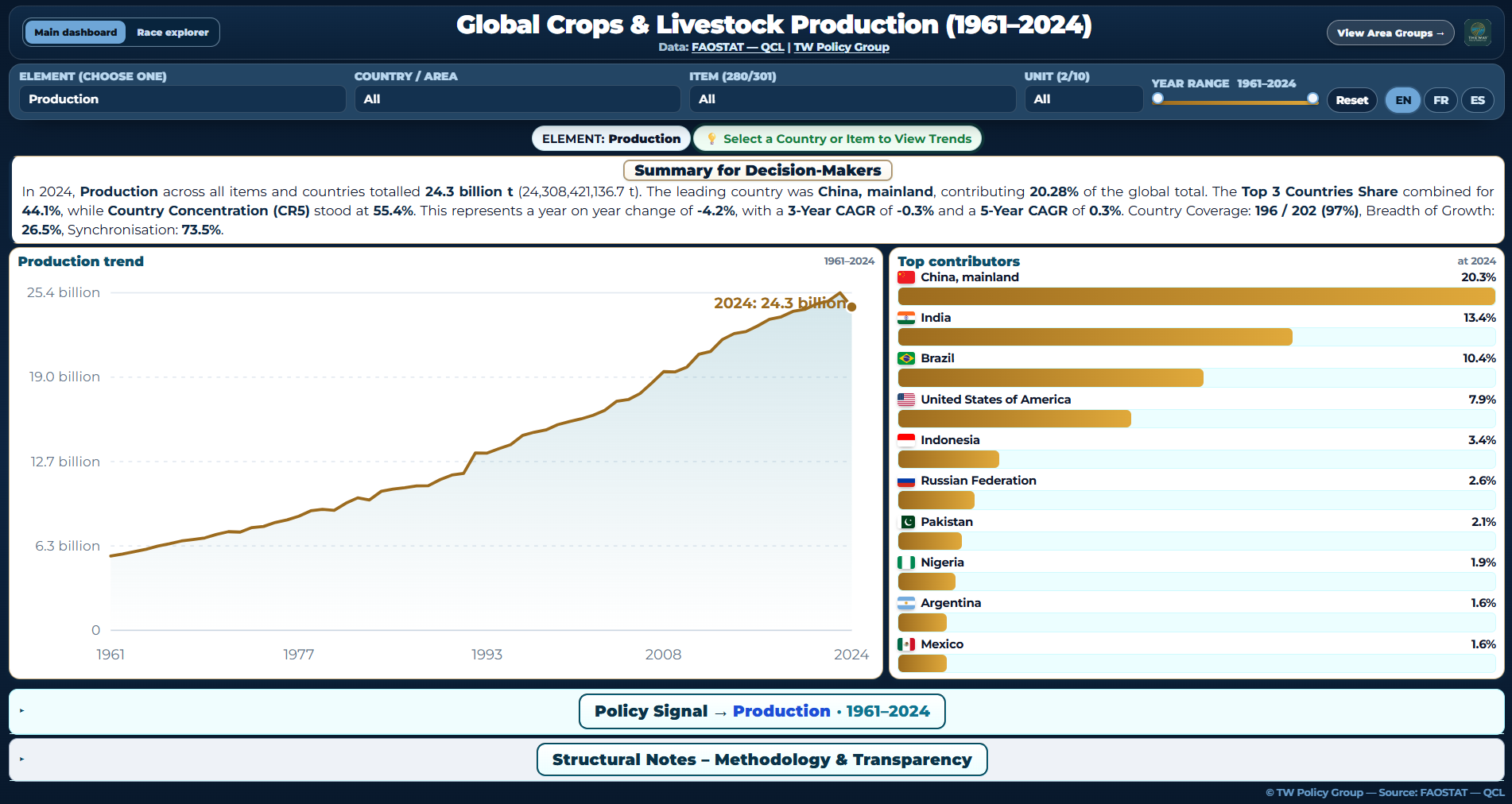
This view shows the dashboard in its most decision-ready state: the Production element is selected, rankings are activated, and the signal panel explains what the current distribution means. It is designed for users who want both the numbers and the interpretation in one screen.

  • See the top-producing countries and products under the currently selected production context.
  • Read structural signals that translate concentration, dominance, and momentum into usable policy language.
  • Use this layout for presentations, benchmarking, and executive briefings where interpretation matters as much as ranking.

Strategic Value for Policymakers, Agribusiness & Development Partners

Global Benchmarking

Compare countries, products, and production systems against world leaders to identify relative position, scale gaps, and strategic opportunities.

Food Systems Strategy

Use long-run production evidence to inform food security planning, national agricultural transformation strategies, and resilience design.

Commodity Intelligence

Track how specific products such as avocado, maize, palm oil, cocoa, or milk evolve across producers and time horizons.

Productivity Interpretation

Move beyond output volume by comparing production, area, and yield elements within the correct unit context.

Import Substitution & Export Planning

Identify where countries already have scale, where productivity can be improved, and where strategic value chains may be competitive.

Research & Policy Briefing

Produce cleaner narratives for ministers, boards, investors, and donor partners using ranked views and dynamic policy signals.

Country Deep Dives

Filter to a single country to understand its leading products, comparative strengths, and structural profile within the world distribution.

Scalable Intelligence Layer

Extend this dashboard with trade, fertilizer, ODA, employment, and country briefing modules to build a fuller agricultural intelligence stack.

Data Disclaimer

Data & Attribution. This page presents a TW Policy Group visualization and production intelligence interface built on FAOSTAT production data. Any underlying source datasets, item classifications, or methodology notes should be cited separately where applicable.

Open Access. Published as a public reference to support evidence-based agriculture policy, food systems planning, market intelligence, and long-run benchmarking. Redistribution is permitted with clear attribution to FAOSTAT as the data source and TW Policy Group for the analysis and visualization.

No endorsement. FAO does not endorse any findings or interpretations contained in this dashboard. Any errors or interpretations are the sole responsibility of TW Policy Group.

Engage Β· Feedback & Updates

Feedback & Questions

Share a question, request an enhancement, or flag a data issue. Your feedback helps improve usability, interpretation, and strategic value of the Global Crops & Livestock Production dashboard.

Subscribe for Updates

Receive updates on new global production dashboards, methods notes, country modules, and tailored agricultural intelligence.